)
See the future of materials innovation at Rethinking Materials
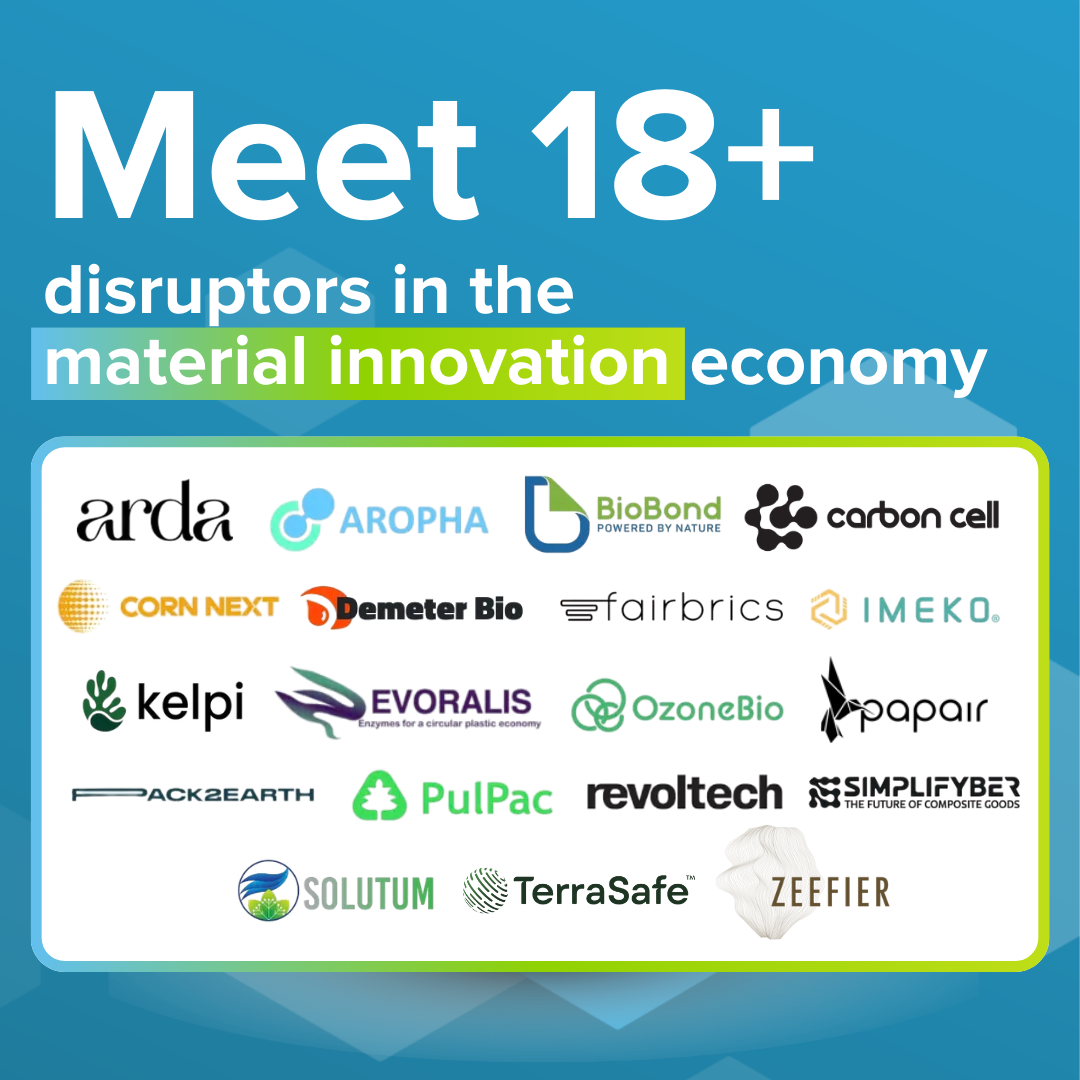
From packaging reinvented with seaweed to leather grown from brewery byproducts, these companies are redefining what’s possible in sustainable materials. On April 28–29, they’ll gather at Rethinking Materials to showcase solutions that are not just environmentally forward-thinking, but commercially ready.
For investors, corporate buyers, and FMCG teams, this is a rare chance to connect with the pioneers shaping the next generation of products - and to get ahead of trends before they hit the market.
Scale-Ups Pitching & Exhibiting: Series A and Above
Discover how next-generation materials are reshaping packaging, textiles, and footwear. This showcase spotlights scale-up companies driving breakthroughs in bio-based, recycled, and regenerative materials that advance circularity and reduce environmental impact. You'll find them at the Technology Showcase: Material Innovators to Watch (April 29, 10:20AM), and at the exhibition throughout both days.
CATCH THEM IN THE SESSION:📍 Technology Showcase: Material Innovators to Watch | April 29, 10:20AM
Papair | Germany
Bubble wrap but made entirely from paper, and fully recyclable. It sounds simple, but the engineering behind it is anything but. Papair has figured out how to make it perform at the level e-commerce and logistics actually need, which is why this one is worth a closer look.
Fairbrics | France
In fashion, a sector long entangled with emissions, Fairbrics (France) offers a radical proposition: textiles made from captured CO₂. Their approach reframes carbon as a resource and invites the industry to imagine synthetic fibres untethered from fossil fuels.
Corn Next | USA
For foodservice and beverage brands, Corn Next is demonstrating what happens when fermentation and material science converge. Their corn‑starch‑derived straws and cutlery show that practical, plastic‑free solutions can emerge directly from nature’s own chemistry.
Revoltech | Germany
Leather alternatives have proliferated in recent years, but Revoltech’s LOVR™ (Germany) stands out for its industrial-level robustness. Plant-based, plastic-free, and circular, it proves that aesthetics and performance can coexist with climate accountability.
PulPac | Sweden
A pioneer in moulded fibre, PulPac (Sweden) continues to push the boundaries of Dry Molded Fiber, a technology now used to create durable lids, trays, and other single-use items with minimal resource use.
Kelpi | United Kingdom
A Bristol-based B-Corp making packaging coatings from seaweed and natural plant oils. Recyclable, biodegradable, and crucially designed to work with existing paper, card, and fibre packaging rather than replace it.
Simplifyber | USA
Simplifyber starts with a cellulose-based liquid and forms products directly - no spinning, weaving, cutting, or sewing. Zero waste by design. It sounds almost too clean, which is probably why the materials world is paying close attention.
IMEKO | Chile
Cigarette butts are one of the most abundant forms of plastic pollution on earth — and almost nobody is doing anything about it. IMEKO is. Their product Celion® turns waste cellulose acetate into a refined industrial input used in eyewear, fashion, and technical components. It's a genuinely unexpected solution to an otherwise neglected problem.
Pack2Earth | Spain
With bio-based, high-barrier materials suitable for both food and non-food goods, Pack2Earth (Spain) offers a plant- and mineral-derived alternative that can even run in existing moulds, making transition tangible rather than theoretical.
Solutum | Israel
It looks like plastic. It processes like plastic. It performs like plastic. But put it in water or soil and it breaks down completely: no microplastics, no toxic residue. Solutum has engineered something that packaging lines can adopt without changing a single machine.
Start-Ups Pitching & Exhibiting: Pre-Seed to Series A
Meet the early-stage innovators presenting new materials and enabling technologies that enhance the circularity of materials and reduce environmental impact. Catch them pitching live at the Technology Showcase: New Materials and Circularity Enabling Technologies (April 28, 10:30AM), and at the exhibition throughout the summit.
Arda Biomaterials | United Kingdom
Leather made from proteins extracted from the waste grain left over from brewing beer. It's exactly as clever as it sounds, and exactly the kind of unexpected circular thinking that tends to age very well. Pitching live — don't miss it. (Pitching Only)
Aropha | USA
Fast, affordable, transparent biodegradability and compostability testing. Not glamorous — but absolutely necessary. If you've ever watched a material innovation stall because testing took too long or cost too much, you'll understand immediately why Aropha matters.
BioBond | USA
Plant-based adhesives and protective coatings that are high performance, low cost, and low in VOCs. Adhesives don't get a lot of headlines, but they're one of the messiest parts of most manufacturing supply chains. BioBond is cleaning that up. Powered by: Generation Food Rural Partners Fund.
Carbon Cell | United Kingdom
Carbon Cell is dedicated to providing a sustainable alternative to traditional polymer-based foams. Their high-performance expandable foam is fully compostable and locks in carbon for centuries. (Pitching Only)
Demeter Bio | United Kingdom
Demeter Bio sits at a genuinely interesting intersection: biology, biomimicry, materials engineering, and sustainable chemistry, all pointed at the same problems. They're early, but the people who meet them first tend to remember the conversation.
Evoralis | United Kingdom
Evoralis uses enzymes to break plastics — polyester, nylon, elastane — back down into their original building blocks. Not downcycled material. The actual monomers, ready to be made into virgin-quality polymers again. True circularity, not the kind that gets rounded up.
OzoneBio | Canada
Nylon 66 needs adipic acid. Making adipic acid conventionally produces a lot of greenhouse gas. OzoneBio makes it from wood waste instead, using a green chemistry process that keeps the emissions down and the value high.
polySCOUT | The Netherlands
polySCOUT accelerates the development of biobased and biodegradable polymers by combining advanced AI with deep polymer science expertise and in‑house synthesis capabilities. Its platform enables companies to rapidly identify and integrate techno‑economically viable sustainable materials into their product portfolios. As part of TNO’s broader initiative to transition plastics toward renewable, low‑impact, and fully biodegradable alternatives, polySCOUT is helping reshape how next‑generation materials are discovered and brought to market.
Terrasafe | USA
Rather than building one material, Terrasafe is building a platform — curating and integrating a portfolio of plastic-free barrier packaging materials so brands can find what they actually need. Think of it as a one-stop shop for the transition away from plastic packaging. Powered by: Generation Food Rural Partners Fund.
Zeefier | The Netherlands
Textile dyes made from locally sourced seaweed. Scalable, safe, consistent, and fully compatible with the dyeing infrastructure that already exists. The textile dye industry has a serious chemistry problem - and Zeefier has a serious answer.
An Invitation to Explore…
On the floor, A Plastic Planet presents PlasticFreeLand - a curated showcase of select commercially ready innovations proving that living beyond plastic isn’t a theory. It’s a choice you can see, touch, and bring into your business today.
Community Clothing: A UK clothing social cooperative manufacturing 100% of its garments in UK factories. The featured product is natural organic cotton sportswear with natural rubber elastic and cotton thread, a direct challenge to the synthetic-dominated sportswear market, and fully compostable at end of life.
SOLK: Swiss-engineered footwear built within a biocircular system. Shoes are made from chrome-free German leather, natural rubber soles, and bio-based linings, with end-of-life industrial composting. SOLK addresses the fact that most modern footwear is a mix of polymers and adhesives that cannot be recycled.
MATTER: A filtration technology company whose device captures up to 97% of microplastics from laundry effluent before they reach waterways, down to 10 microns. Designed on Cradle to Cradle principles, with over 97% of the product recyclable.
The Bottle Collective / Pulpac: Dry Moulded Fibre bottles made from at least 90% renewable pulp fibres, recyclable through existing paper streams with over 85% fibre recovery. A low-carbon, scalable alternative to single-use plastic and glass bottles.
YULEX: Plant-based natural rubber materials offering direct replacements for neoprene and elastane. YULEX foam and YULASTIC fibres deliver equivalent stretch and performance for wetsuits, apparel and gear, while cutting raw-material carbon footprints by approximately 80–95% versus fossil-based synthetics.
SEEP: B Corp-certified maker of natural, microplastic-free cleaning essentials. All products are made from sustainably sourced, compostable or endlessly recyclable materials, with no single-use plastics.
TERRAMTECH: A material science company producing 100% plant-derived, bio-based coatings for food packaging that match plastic on performance for oil, grease, oxygen and moisture barriers. Fully compostable and biodegradable at end of life.
The conversations that shape the future happen in person.
We read a lot about what materials could become. At Rethinking Materials, you see what they already are - on display, explained by the founders who built them from the ground up.
The deals don’t happen on LinkedIn. The partnerships that make headlines start with a question at a booth, a coffee between sessions, or a conversation sparked after a pitch. If you want to be at the forefront of materials innovation, this is the room where it all begins.
Come curious. Leave with new contacts, firsthand insights, and a clear view of the innovations your competitors haven’t even seen yet. Register today at www.rethinkingmaterials.com/book-tickets
)
)
)